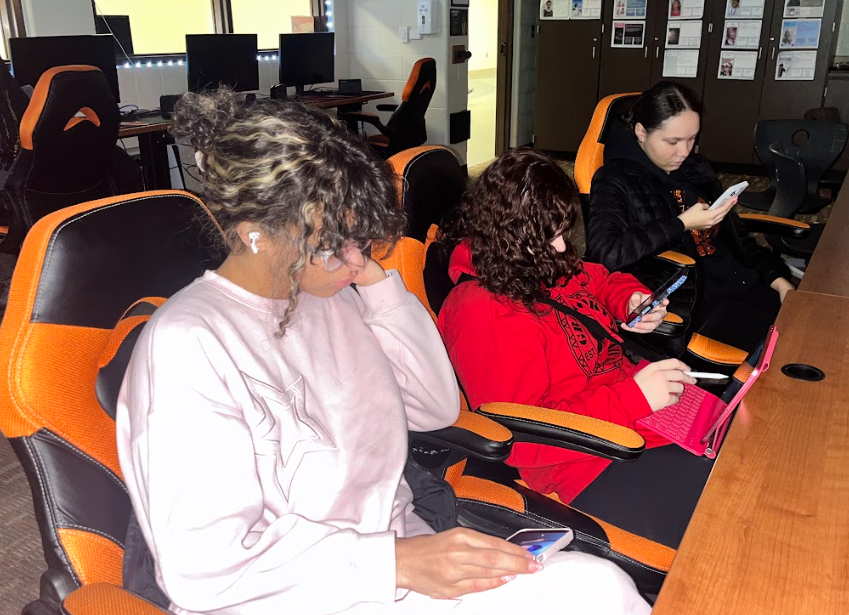
Michigan Governor Gretchen Whitmer signed a classroom phone ban on Tuesday, February 10. The phone ban is set to be implemented in all Michigan K-12 schools commencing in the 2026-2027 school year. This ban is designed to prevent interference with learning, though it has sparked controversy among students and parents.
According to michiganpublic.org, phones are to be outlawed during instructional time in class, but further prohibitions are to be left up to the district to decide. While some say this ban will make students “fully present”, leading to further participation and retention, others may argue that this will hinder the safety of students in schools. Michigan parent Jackie Fann stated it was important to “not feel that anxiety that we feel as a parent in today’s society. You feel it every morning when you send them off to school,” according to WLNS news.
As for BHS, many students have questioned what exactly this phone ban will entail. According to administration, the rules won’t stray too far from typical district protocol; however, they will be more heavily enforced. All electronic devices, aside from ones issued by the district, are to be away during instructional times. This includes smart watches, phones, tablets, and other devices.
BHS has current protocols and a cell phone policy that is clear; however, enforcing cellphone rules has been notoriously difficult.
“There is already a cell policy not to be used during instructional time as it is; if anything, we must be better about enforcing what’s already supposed to be happening.” Says Principal Crockett. “Right now, it varies from class to class and it shouldn’t. There are no plans to be different, just to be better. I think everybody needs either the same thing, or a thing. Some classes have containers, some have calculator catties, some have phone jails, so we will probably get it down to just one or two options so it’s very clear.”
Safety concerns prompt controversy over the Michigan phone ban. Parents and students alike want to be able to contact each other when necessary. To administration, this unease is understandable. BHS has a phone in every classroom, security guards, and safety policies set in place. “I think what really concerns people is not having automatic access all the time.” Says Principal Crockett. Parents are contacted immediately when something happens and cannot get into the building without permission. Phones could be a false sense of safety, possibly stressing parents out even more by going back and forth with their child.
As stated by radio.wcmu.org, test scores have plummeted in the US within the past decade amidst the rise of phone usage. There is a direct correlation between smartphones, cognitive performance, and attention spans. It is difficult to focus on multiple things at once; if students are missing the point and information, it will be harder for them to learn. Phone restrictions drive educators to ensure that they are teaching engaging lessons and checking in on students. The cellphone is not the babysitter; restriction takes away that crutch of not having planned enough.
With students being so heavily reliant on screens, the schoolwide atmosphere will vary with the new phone laws. Test scores, attention spans, and engagement among students is expected to rise. Although students and parents are concerned for school safety, policies are put into place to ensure protection. With one consistent protocol enforced in each classroom, the device restriction is set to improve focus within BHS.