

















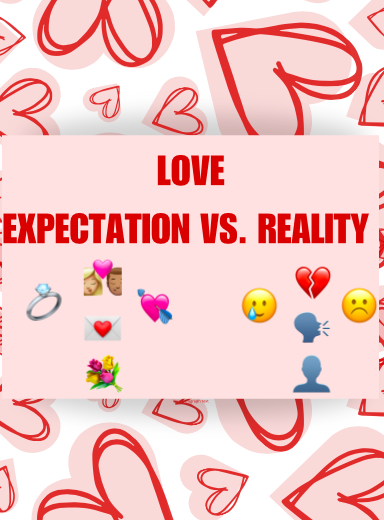
Many viewers love rom-coms and the feelings of romance and hope they inspire. However, if you step out of the screen and into reality, you can see how unrealistic these situations of love are compared to real relationships. While movies in the rom-com genre are entertaining and bring a good feeling to viewers, they can often make people’s expectations of love in reality seem unrealistic.
Some examples of beloved rom-coms (romantic comedies) include 10 Things I Hate About You, To All The Boys I’ve Loved Before, She’s All That, She’s the Man, and Clueless. Rom-coms often set high standards for real relationships like grand gestures, meet cues, and happy endings. These expectations can often leave people feeling disappointed because, unfortunately, that isn’t the reality of relationships in today’s time.
A common unrealistic setup in rom-coms is the fast-paced timeline of falling in love with a person. It isn’t realistically common to be in love and have found the love of your life after a month or so. Relationships and connections take time to develop and rushing into something so quickly can lead to not seeing red flags and discovering incompatibility later on as you get more invested into the relationship. Over time, experts have developed “The 18-Month Rule” (also known as the Honeymoon Phase) for relationships. This often means that after this period is over, and a physical relationship is prioritized rather than an emotional connection, the relationship can crumble after the initial attraction wears off. An ELLE article shows this by saying how many harsh realities hit at the 18 month (1 year + ½) to 2 year mark of a relationship. This shows how rushing into relationships can be harmful, especially if a proper foundation hasn’t been established between two people, because physical attraction can only be so much for some people.
Another unrealistic norm of rom-coms is sweet happy endings. Now these aren’t always uncommon because some people’s relationships are genuinely happy after initially getting together, but it’s not always the case. A lot of relationships go through hardships that movies don’t always go in-depth on or brush under the rug to keep the happy mood. Even when small problems are brought up, there’s never really a solid resolution to them in the end. For example, I asked a student “what is something that makes rom-coms look easy, but in real life is difficult?”. The student said they would watch rom-coms when they were younger and were “blindsided” when they were introduced to what love today is really like. They also said that rom-coms make relationships look so effortless through struggles, but then they later realized that real relationship problems aren’t properly represented. This can show how young people’s perception of happy endings is altered by rom-coms, because there are no real hardships being showcased.
Lastly, rom-coms often show how public displays of affection are indicators to show real love between two people. This isn’t the case because what you see happening in public or on social media isn’t always true to what’s happening behind closed doors. People today tend to compare themselves or their personal relationships to what they see in the media. However, what matters most is what’s kept private between you and your person because not all moments need to be a public display. An article from Carrie Smith, an associate professor of psychology at Ole Miss claims that the more media we consume, the more we internalize these ideas or create them as our norm (Smith, 2024). This shows how media (including movies) is harmful to people’s ideas of relationships because unhealthy standards can be seen as normal because the media is making it seem as such, and young impressionable people may not see the harm in it..
Some may argue that rom-coms are only fictional movies and they don’t affect people’s real-life perceptions. While they are only fiction, the media is so popular with young people who are easily influenced and that’s often how trends start online. Something like relationships should be portrayed realistically so young people don’t get their hopes up and know what to expect when searching for love in real life. ACT for Youth says 95% of high school students reported through a survey that technology and social media have had an influence on their romantic relationships and that it sets unrealistic expectations for them. This shows how social media has a harmful effect on young people’s perception of relationships because they’re focused on the media rather than discovering their own perception.
There are many unrealistic aspects of relationships displayed in rom-coms like fast-paced timing of relationships, unrealistic happy endings, and wrong assumptions about public displays of affection. It’s important for young people especially to separate fact and fiction when consuming media like movies. Rom-coms can be very enjoyable, but be sure to proceed with caution when setting your own expectations for relationships.